
Provably fair is the one claim in crypto gambling you can check for yourself, in about two minutes, without trusting the casino's word or its licence. This guide shows exactly how, with the maths kept in plain English, plus where the guarantee ends, because it's narrower than most sites imply.
What provably fair actually means
A provably-fair game lets you prove, after the fact, that the result of a bet was decided before you placed it and was not altered to make you lose. It does that with cryptography rather than a regulator's promise. That is the whole appeal: a Curaçao or Anjouan licence tells you an operator filed paperwork; a provably-fair verification tells you a specific round was honest, and you did the checking.
It rests on three ingredients working together.
- Server seed, a random string the casino generates and keeps secret while you play. This is the piece that could, in theory, be rigged, so it's the piece you get to audit.
- Client seed, a string your browser generates, and which you can change to one you pick yourself. Because you control it, the casino can't know the full recipe in advance.
- Nonce, a counter that starts at zero and goes up by one with every bet on the same seed pair, so each round has a unique input.
Before you place a single bet, the casino shows you a SHA-256 hash of the server seed. A hash is a one-way fingerprint: the same input always produces the same 64-character output, but you can't run it backwards to recover the input, and changing even one character of the seed produces a completely different hash. By publishing that fingerprint up front, the casino commits to a server seed it can no longer change. That commitment is the trick the whole system turns on.
The six-step verification, in practice
Here is the routine we run on any new provably-fair game. It works the same way on Stake, BC.Game, Rollbit, Roobet and the rest, because most of them use variations of the same engine.
- Open the fairness panel first. On a Stake-style client it sits under the game menu or a "Fairness" tab. Copy the hashed server seed shown there and paste it somewhere you'll not lose it.
- Set your own client seed. Do not leave the default. Type a string you chose, so nobody can argue the site picked a convenient one.
- Play your rounds. Watch the nonce tick up. If you want to verify one specific bet later, note its nonce.
- Rotate the server seed. When you switch to a new seed, the old one is "unsealed" and the casino reveals it to you in plain text. You can't see a seed until you have finished betting on it, which is the point.
- Re-hash the revealed seed. Drop the plain-text server seed into any SHA-256 tool, an offline one is cleanest, and check the output matches the hash you copied in step one. A match proves the seed was fixed before your first bet. No match means walk away and screenshot everything.
- Recompute a result. Each game's fairness docs publish the exact formula that turns (server seed, client seed, nonce) into an outcome. Feed your three values in and the number should equal the result you actually saw. For the common engines you don't have to code it yourself, independent verifier pages exist.
A worked example, so the formula is not a black box
Say you played Dice. The site committed to the hash a3f9...c21 before you started. You set your client seed to myseed7, placed three bets, then rotated the seed and got the plain server seed 9b2e...f04 back. You hash 9b2e...f04 yourself and it produces a3f9...c21, identical to the commitment, so the seed was locked in. Now you take that server seed, your myseed7, and nonce 2 for the third bet, run them through the game's HMAC-SHA256 formula, and it outputs the roll 54.19. If 54.19 is what the screen showed, that round is mathematically confirmed. Do it once and the abstract idea becomes concrete.
Which games and casinos support it
Provably fair applies to a casino's own "Originals," not to third-party slots. Slots from studios like Pragmatic Play or Hacksaw use certified RNGs audited by labs such as GLI or iTech Labs instead, which is a different kind of assurance. The house games you can personally verify are the crash-and-dice family:
| Game | What it is | Typically verifiable? |
|---|---|---|
| Dice | Roll over or under a target | Yes |
| Limbo | Set a target multiplier, hope the roll clears it | Yes |
| Crash / Aviator | Cash out before the curve busts | Yes |
| Mines | Reveal tiles, avoid the bombs | Yes |
| Plinko | Ball drops through pegs into multipliers | Yes |
| Keno | Pick numbers, match the draw | Yes |
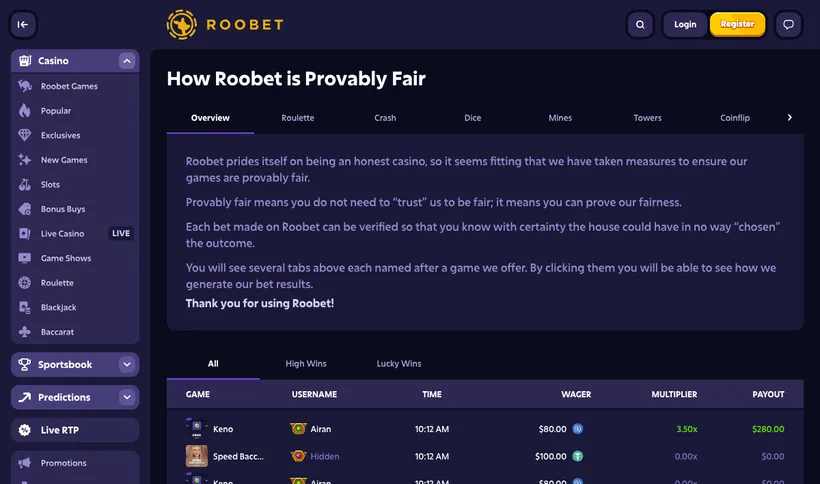
Among the operators we track, the ones running first-party provably-fair Originals include Stake (the reference implementation everyone clones), BC.Game, Rollbit, Roobet, Wild.io and Shuffle. Aggregator-style casinos that lean on third-party libraries may advertise "provably fair" loosely, so check whether the specific game exposes a seed panel before you take the label at face value.
Where the guarantee stops
This is the part the marketing skips. Verifying a round proves only that that round was not tampered with after you bet. It says nothing about whether the casino will pay a large withdrawal, whether the bonus terms are fair, or whether support will answer when a dispute starts. A site can run genuinely provably-fair games and still stall your cash-out behind a surprise KYC check. So treat provable fairness as one strong signal among several, alongside a real licence, a track record of paying disputes, and a KYC threshold you understand before depositing. It's more than a licence alone buys you, and less than a clean bill of health.
Provably fair FAQ
Can a provably-fair casino still cheat me?
Not on a verified individual round, the maths rules that out. But it can still treat you unfairly elsewhere: slow or refuse a withdrawal, bury a punishing wagering requirement, or apply a bonus max-bet rule to void winnings. Provable fairness covers the game outcome, not the operator's conduct, which is why we weight licence and payout reliability alongside it.
Do I need to be technical to verify a game?
No. Copying a hash, setting a client seed and pasting a revealed seed into an online SHA-256 checker takes a couple of minutes. For recomputing the actual result, independent verifier pages exist for the common Stake-engine games, so you rarely need to run the formula by hand.
Are slots provably fair too?
Usually not in the same way. Third-party slots use certified RNGs audited by testing labs (GLI, iTech Labs, eCOGRA) rather than a seed you can check yourself. Provably-fair verification is for a casino's own Originals, Dice, Crash, Mines, Plinko, Limbo and Keno.